


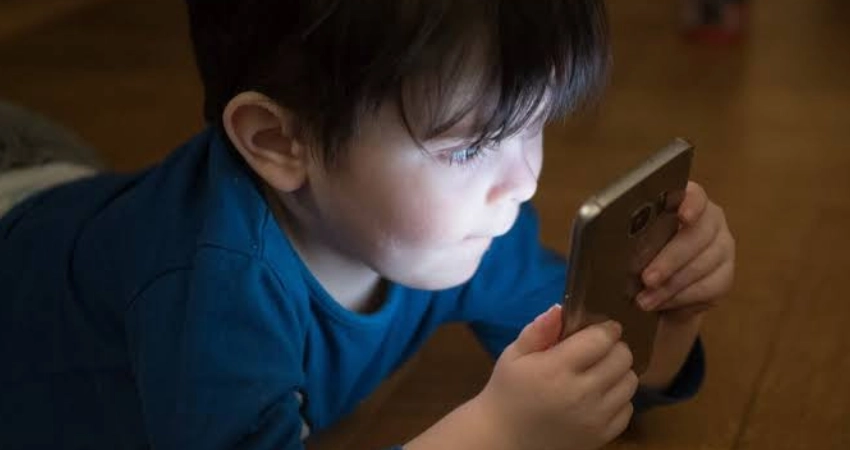
The mobile phone itself is not a single, direct cause of speech delay in children. However, it can become an important contributing factor when it is used for long periods and without clear limits. Children learn to talk mainly through real, two-way interaction with parents and people around them: looking at faces, copying gestures, listening to tone of voice, and responding with sounds or movement. When a child spends a lot of time in front of a phone, this live interaction decreases, which can affect language development.
Table of Contents
Many studies have found an association between high screen exposure in the first years of life and a greater chance of speech delay or weaker social communication skills. This is especially true when devices are used before the age of two and without adult participation. This association does not mean every child who uses a phone will have a speech delay. It does mean that excessive use raises the level of risk.
So it is fair to say: yes, frequent and prolonged use of mobile phones and other screens, combined with little talking, playing, and face-to-face interaction, can contribute to speech delay in children, especially in more sensitive children or those who already have other risk factors. Each child should be assessed individually by a qualified professional if there are concerns about language development.
How Does Mobile Phone Use Affect Language and Communication Development?
A child’s language development depends mainly on direct interaction with parents and caregivers: eye contact, facial expressions, tone of voice, conversation, and responses. With excessive mobile phone use, a large part of this human interaction is replaced by contact with a silent or one-way screen. This is at the heart of the problem.
The main ways mobile phone use can affect language and communication development include:
1. Fewer Opportunities for Verbal and Social Interaction
When a child is absorbed in watching videos or playing games on a phone, there is usually less:
- Talking from parents and caregivers (because the child is “quiet and occupied”).
- Response from the child when their name is called or when questions are directed to them.
- Pretend play and back-and-forth conversation with others, which are among the strongest drivers of language development.
2. Passive Rather Than Active Language Learning
Children learn to talk best when they:
- Hear a word.
- Try to repeat it.
- See the speaker’s face and read facial expressions and gestures.
With mobile phone use, the child is often just a passive receiver. They are not practicing how to produce sounds, take turns in conversation, or use words in real-life situations. As a result, the appearance of first words and more complex language structures may be delayed.

3. Distracted Attention and Weaker Concentration
Fast switching between clips, bright colors, and loud music trains the child’s brain to expect constant high stimulation. This can make it harder to:
- Focus on one person speaking for more than a short time.
- Follow a simple story told by a parent or caregiver.
Poor attention and concentration directly affect how easily a child can learn new words and understand sentences.
4. Replacing Real Play With Screen Play
Physical and pretend play (such as playing “kitchen,” “car,” or “doctor”) creates a rich environment for language use: describing things, asking questions, making requests, and having conversations.
When a child replaces most of this with phone games, they lose daily chances to try out words in natural situations. Over time, this may contribute to speech delay in some children, especially when screen use is prolonged and there is limited family interaction.
That said, the impact depends on total screen time, the child’s age, and how the family manages device use, not on the mere presence of a phone in the home.
Factors That Increase the Risk of Speech Delay With Mobile Phone Use
Not every child who uses a mobile phone will develop a speech delay. Certain factors make screens more harmful and increase the likelihood of language delay. Understanding these factors helps parents adjust their child’s phone use and reduce potential harm.
Key factors that raise the risk of speech delay in children due to mobile phone use include:
1. Very Early Introduction to Mobile Phones
The younger the child when exposed to screens, the more sensitive their brain is to possible negative effects. Children under two years old need far more live interaction with people than digital content, because language builds through looking at faces, watching lip movements, listening to tone of voice, and taking turns in conversation.
2. Number of Screen Hours per Day
Frequent and prolonged use of the phone, especially beyond age-based recommendations, is clearly linked to a higher chance of speech delay.
The risk is greater when:
- The child uses a mobile phone daily for long stretches without breaks.
- The child watches content alone, without interaction with a parent or caregiver.
3. Type and Quality of Content
Very fast-paced content full of loud visual and sound effects, but with little or unclear speech, does not support language learning. Content that is not age-appropriate, is in multiple languages the child does not understand, or games that rely only on tapping and swiping without meaningful speech or interaction, can keep a child busy without adding to their vocabulary or expressive skills.
4. Using the Mobile Phone Instead of Daily Interaction
The impact of mobile phones is more harmful when they replace:
- Daily conversation with the child.
- Reading stories aloud.
- Pretend and interactive games (such as hide-and-seek or role play).
The less time a child spends in real interaction with adults and peers, the higher the chance that speech delay will appear, even if at first their language seemed on track.
5. Lack of Rules and Parental Supervision
Allowing the child to control when and how long they use a phone, and what they watch, increases the risk of speech delay.
When there are no clear limits (when, how long, what content, and with whom), this often leads to:
- Excessive use.
- Age-inappropriate content.
- Greater social and language isolation.
6. Other Existing Child or Family Factors
Some factors are not caused by the mobile phone, but make its impact stronger, such as:
- General developmental delay or an undiagnosed hearing problem.
- A family history of speech and language delay or language disorders.
- A language-poor environment (little talking with the child, lack of reading and storytelling).
In these situations, excessive mobile phone use becomes an additional burden that can worsen the picture. Managing screen use is therefore especially important for these children.
Warning Signs of Speech Delay in Children That Deserve Attention
It is normal for children to vary in how fast they acquire speech, but certain signs, when they are obvious and persistent, may indicate a delay in language development, particularly when combined with heavy mobile phone or screen use. Recognizing these signs early helps parents seek support at the right time.
It is always important to look at the whole child, not just one sign, and to follow their progress over several months rather than focusing on a single day.
From 12 to 24 Months
In this stage, children usually move from babbling to first words and begin to understand simple commands. Signs of concern at this age may include:
- Frequently not responding to their name, or seeming not to hear you at times.
- Very little babbling or vocalizing (not producing varied sounds such as “ma,” “ba,” “da”).
- Not trying to imitate sounds or facial expressions.
- By the end of the first year: not saying any meaningful word like “mama” or “dada” in a directed way.
- At around 18 months: not using at least several simple words, and not trying to communicate through pointing or other gestures to indicate what they want.
- Long periods of being absorbed by a phone or screen, with little turning to or interacting with people around them.
If you notice that your child prefers looking at a screen over interacting with you or siblings, and several of these signs are present, it is wise to seek professional advice.
From 2 to 3 Years
Between two and three years, vocabulary usually increases rapidly and children begin forming short sentences. Signs that may suggest speech or language delay include:
- Around age 2: not using two-word phrases such as “mummy come” or “want water.”
- A very limited vocabulary (far below what is typical for age), or no steady addition of new words over time.
- Clear difficulty understanding simple instructions, such as “put the toy here” or “come sit.”
- Relying on pointing or pulling a parent’s hand instead of using words to express needs.
- Speech that is almost completely unclear to people outside the family, or mainly repeating phrases heard in videos without using words in a meaningful context (echolalia/parroting).
- Preferring mobile phones or tablets for long periods instead of interactive play or talking with adults.
When several of these signs are present, especially alongside heavy phone use, it is important to reduce screen time, increase interactive communication, and request an assessment from a speech and language therapist or child development specialist.

After 3 Years of Age
After age three, a child’s speech is expected to become much clearer and their expressive skills significantly better. Signs of concern after this age may include:
- Speech that is not understandable to most people outside the family between 3 and 4 years of age.
- Difficulty forming simple, complete sentences, or mainly using single words to communicate.
- A vocabulary that appears limited compared with peers, or difficulty naming familiar objects in the environment.
- Inability to answer simple questions such as “What is your name?” or “How old are you?” while keeping in mind individual differences.
- Not being able to take part in a simple conversation with adults or other children, or choosing to remain silent in groups.
- Continuing to rely heavily on mobile phones or videos, with noticeably little verbal interaction (questions, answers, storytelling) with the family.
If these signs persist, if you notice a loss of skills after speech had been better, or if the child spends long hours on a phone instead of playing and talking, then a professional evaluation becomes very important to identify the cause and plan appropriate support.
Is the Mobile Phone the Only Cause of Speech Delay?
Mobile phone use is an important factor that can contribute to speech delay in children, but it is rarely the only cause. Speech delay is often the result of several overlapping environmental, medical, and genetic factors, which differ from one child to another.
Other common causes of speech delay, in addition to mobile phone use, include:
- Hearing loss or recurrent ear infections, which prevent the child from hearing speech clearly and learning sounds and language in a typical way.
- Overall developmental delay or neurodevelopmental conditions such as autism spectrum disorder or learning difficulties.
- Family history: if a parent or sibling had speech or language delay, the risk is higher.
- A language-poor environment, even without phones: little conversation with the child, lack of stories and discussions, or relying on television instead of direct interaction.
- Psychological or social factors such as neglect, high stress at home, or major life changes (moving house, a new sibling, etc.).
Therefore, it is not enough to blame the mobile phone alone. If a child’s language seems delayed, they should be evaluated by a pediatrician or speech and language therapist to explore all possible causes and develop a suitable plan, with mobile phone management as one part of the solution rather than the entire answer.
Read More: Autism Spectrum Disorder: Early Signs and How Early Intervention Helps?
How Can You Reduce the Impact of Mobile Phones on Language Development?
Reducing the impact of mobile phones does not always mean banning them completely. It means using them in a controlled way while providing a rich environment for speech and interaction. What matters most is how much real-life communication the child gains compared with the time spent on screens.
The following practical tips can help protect your child’s language development:
1. Set Clear Limits on Screen Time
- For children under 2 years: it is preferable to avoid screens as much as possible, except for brief video calls with family.
- For children 2–5 years: many guidelines recommend limiting total screen time to about one hour per day of high-quality, age-appropriate content, ideally with an adult present.
- Avoid using the phone as the default tool to calm or silence the child in every situation.
2. Apply the “Screen With a Grown-Up” Rule
Co-viewing with an adult reduces the risk of speech delay in children due to mobile phones because the child hears extra words, questions, and comments from the parent or caregiver.
- Talk with your child about what they see on the screen.
- Explain pictures, name objects, and ask simple questions like: “What do you see?”, “What color is this?”, “Who is that?”
3. Offer Language-Rich Alternatives
Every minute away from the phone can turn into a language-learning opportunity:
- Read stories aloud every day with expressive facial and vocal tone.
- Sing songs and nursery rhymes, and play language games (such as “Where are your eyes?” “Where is your nose?”).
- Encourage pretend play (doctor, shopkeeper, kitchen), which naturally stimulates speech and conversation.
4. Turn Everyday Moments Into Chances to Talk
- During meals: talk about the type of food, its color, and taste.
- In the car or while walking: name things in the street, colors, and sounds.
- During daily routines (bath, getting dressed): describe what you are doing step by step, even if the child does not respond much at first.
5. Keep Phones Away From Key Times
- Mealtimes, free play time, and the period just before bedtime are best kept screen-free.
- Avoid having the TV or videos on in the background for long periods, as constant noise can distract the child from speech and interaction.
6. Be a Role Model in How You Use Your Phone
- If children see their parents constantly on their phones, they learn that screens are more important than talking.
- Put your phone aside when playing with your child or talking to them, and give them full visual attention (looking at their face and eyes).
7. Choose Appropriate Content When Screens Are Used
If mobile phone use is necessary:
- Choose educational apps and programs with a slower pace, without excessive flashing colors and loud sounds.
- Prefer content that encourages repetition, singing, and naming objects rather than only fast, continuous viewing.
- Remember that even “educational” content cannot replace direct interaction with a responsive adult.
8. Observe and Monitor
- Watch how the phone affects your child: Do they become calmer or more irritable? Does eye contact or their use of speech decrease as screen time increases?
- If you notice your child refusing to play or interact without a screen, or their language seems limited compared with peers, cut back on screen time, focus more on talking and playing together, and consult a specialist if your concerns continue.
With these steps, you can reduce the negative impact of mobile phones on language development and give your child an environment that encourages speech and communication, recognizing that each child is unique and may sometimes need tailored professional guidance.
Read More About: When Does a Child Need a Psychological Evaluation? Signs You Shouldn’t Ignore

When Should You See a Speech Therapist or Child Development Specialist?
It is normal for speech development to vary among children, but some signs call for a specialist’s opinion, particularly if the child spends a lot of time on phones or other screens. Early evaluation does not automatically mean there is a serious problem. It is mainly a way to get reassurance and, if needed, a suitable support plan.
It is advisable to seek an assessment from a speech and language therapist or a child development specialist in the following situations:
- If the child is not babbling clearly or producing varied sounds after about 9–10 months of age.
- If the child has not said any meaningful word such as “mama” or “dada” between 12 and 18 months.
- If the child has not started combining two words together (for example, “want water”) after about 2–2.5 years.
- If their speech is almost entirely unclear to people outside the family after age 3.
- If the child’s speech regresses after having been better, especially when this coincides with increased phone use.
- If you notice reduced eye contact, poor response to their name, or near-total dependence on the mobile phone for entertainment.
- If the child seems to understand very few simple, age-appropriate instructions.
- If, as a parent, you have an ongoing feeling that your child’s language development is “not normal” compared with peers.
In all these cases, it is better not to wait or rely only on reducing mobile phone use. Book an appointment with a qualified professional. The earlier the intervention, the better the chances of improvement, while always remembering that each child is an individual case that needs a personalized assessment.
How Does Early Intervention Help Treat Speech Delay?
Early intervention means starting to help the child as soon as signs of speech delay are noticed, rather than waiting for them to “grow out of it.” The younger the child when treatment begins, the better the chances for improvement in speech, language, and communication, especially when speech delay in children due to mobile phones is only part of the overall picture and not the sole cause.
Early intervention can help by:
- Stimulating language centers in the brain at a time when the brain is most flexible and responsive to training.
- Correcting behavior patterns related to screen use (such as withdrawal, limited eye contact, and poor response to name).
- Teaching parents communication strategies that actively promote language, not just reducing mobile phone use.
Early intervention usually includes:
- Sessions with a speech and language therapist to help the child produce sounds correctly, understand instructions, and use simple words and sentences.
- Guidance for parents on creating a realistic plan for screen use (limiting phone time, choosing appropriate content, and making viewing more interactive rather than passive).
- Simple home activities such as reading aloud, singing, pretend play, and describing what the child sees and hears throughout the day.
Outcomes of early intervention vary from child to child depending on the cause and severity of the delay, but starting early often prevents the problem from worsening, reduces the negative impact of mobile phones on language development, and helps the child catch up with peers as much as possible.
Get a Professional Assessment If You Are Worried About Your Child’s Language Development
If you feel your child’s language is not developing as expected or you suspect that mobile phone use has affected their speech, the safest step is to seek a professional assessment rather than just waiting or only “keeping an eye on it.” Early evaluation does not mean your child has a serious disorder. It is a way to make sure, get reassurance, and plan support if needed.
In most cases, it is helpful to start with:
- Consulting your pediatrician or family doctor to review overall development and rule out hearing issues or other medical causes.
- Requesting a referral to a speech and language therapist or a child development specialist for a more detailed assessment.
During the assessment, the professional may:
- Ask about pregnancy and birth history, your child’s motor and language development, and their habits around mobile phone and screen use.
- Observe your child’s interaction, response to sounds, ability to imitate, and attempts to use words or gestures.
- Recommend a plan, which may include reducing screen time, speech therapy sessions, or regular follow-up, depending on the situation.
Do not wait for things to “fix themselves” if your concern persists. Differences between children are normal, but getting reassurance through a specialized evaluation is better than regretting a delayed intervention, especially when there may be speech delay in children due to mobile phones or other contributing factors.