

Table of Contents
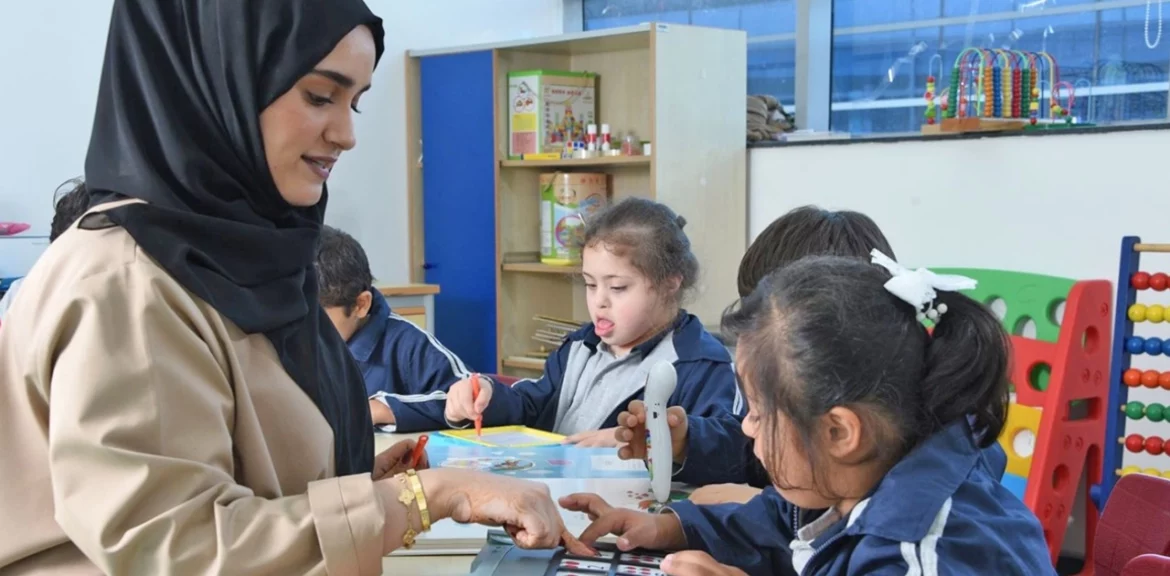
Early intervention for children plays a critical role in identifying developmental delays at an early stage, allowing timely therapeutic support that significantly improves long-term outcomes. At Waad Center, comprehensive evaluations are designed to detect language, motor, social, and autism-related challenges using evidence-based assessment tools.
When does a child need early intervention?
A child needs early intervention when parents or the pediatrician notice a clear delay in developmental milestones compared with children of the same age—for example, a delay in sitting, crawling, or walking, or a delay in speech, such as not using words, not responding to their name, or not reacting to surrounding sounds.
It is also advisable to seek early intervention services if the child has difficulty with eye contact, shows significant behavioral issues such as marked hyperactivity or social withdrawal, or exhibits early signs suggestive of autism spectrum disorder or learning difficulties.
Early intervention becomes even more critical for children born prematurely, those with a family history of genetic disorders or developmental delay, or children who have experienced perinatal complications such as lack of oxygen at birth or neurological problems.
The earlier a developmental delay is detected and appropriate therapeutic and rehabilitation programs are started, the better the chances of improving the child’s motor, language, cognitive, and behavioral skills. This highlights the importance of regular follow‑up of the child’s development with the pediatrician, as well as with occupational therapists and speech‑language pathologists, within structured early intervention programs.
Types of Developmental Delay in Children
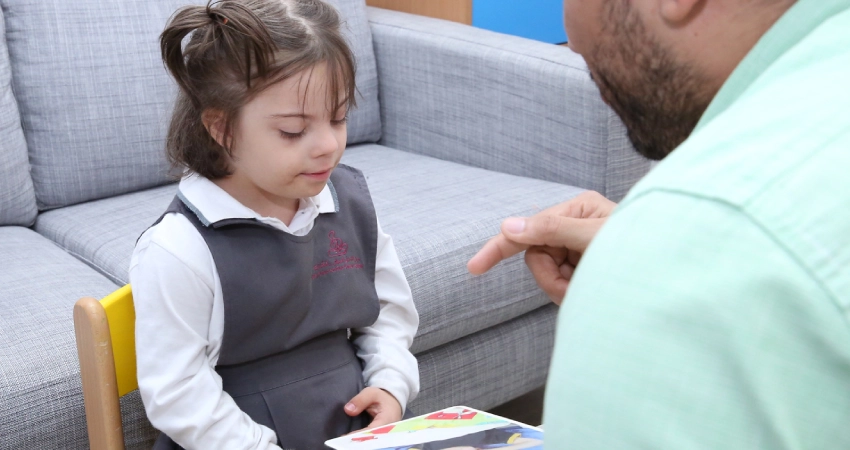
Early intervention for children with language delay improves communication skills before school age.
Language and Speech Delay
At Waad Center, the evaluation of language and speech delay begins with a comprehensive assessment of the child’s receptive and expressive abilities, comparing their language skills with the expected developmental milestones for their age.
Speech and language therapists administer standardized assessments and directly observe how the child communicates with parents and others within a play-based environment.
The assessment focuses on the size of the child’s vocabulary, sentence structure, sound production (articulation), as well as their ability to understand both simple and more complex instructions.
This early diagnostic process helps determine whether the delay in speech is part of a broader developmental delay or a specific language disorder, guiding the development of an appropriate early intervention plan tailored to each child at Waad Center.
Read More: Speech Therapy for Children: A Complete Guide to Signs, Causes, and Treatment
Motor Delay
When motor delay is suspected—such as delayed sitting, crawling, or walking—the team at Waad Center conducts a scientifically grounded assessment of both fine and gross motor skills.
The child’s balance, muscle strength, and control of hand and finger movements are examined, alongside observation of how the child grasps toys and transitions between different positions.
Physiotherapists and occupational therapists use internationally standardized developmental tools to accurately determine the child’s motor development level compared with peers of the same age.
Based on this evaluation, an individualized early intervention program is designed to improve motor skills and enhance the child’s independence in everyday activities.
Social Skills Delay
The assessment of social skills delay at Waad Center includes observing how the child interacts with others, their ability to maintain eye contact, and their responses to a parent’s smile or calling their name.
Specialists evaluate the child’s participation in shared play, their ability to imitate actions, and how they express emotions and needs in ways that are appropriate for their developmental stage.
Standardized behavioral and social assessment tools are used to detect early signs of social interaction difficulties, even when they are subtle at the beginning.
This type of assessment is a cornerstone of early intervention programs, as it enables both the family and the therapeutic team to support the child in building healthy relationships and self-confidence from the earliest years.
Autism Spectrum Disorders
At Waad Center, the diagnosis of Autism Spectrum Disorders (ASD) is conducted within a comprehensive early-intervention framework and is based on observing the child’s behavior across multiple settings, alongside the use of internationally validated diagnostic scales.
The evaluation focuses on three main domains: communication (both verbal and nonverbal), social interaction, and the presence of repetitive behaviors or restricted interests.
Detailed information is gathered from parents regarding the child’s developmental history, onset of symptoms, and patterns of interaction at home, daycare, or preschool.
Early diagnosis of ASD supports the development of an individualized intervention plan that may include behavioral therapy, social skills training, and language support, thereby providing the child with the best possible opportunities for balanced growth and development within the supportive environment of Waad Center.
How is a child assessed at Waad Center?
At Waad Early Intervention Center, the diagnostic process begins with a comprehensive assessment that integrates medical, psychological, and educational evaluations to build an accurate picture of the child’s developmental and behavioral needs.
The team first takes a detailed medical and developmental history from the parents, including the child’s milestones, patterns of communication, behavior, and any learning difficulties or language delays, if present.
The child is then given a range of standardized assessments, including developmental scales, intelligence (IQ) tests, speech and language assessments, and evaluations of both fine and gross motor skills. In addition, the team carefully examines the child’s social interaction, attention span, and concentration.
The professionals at Waad rely on scientifically validated tools to diagnose conditions such as Autism Spectrum Disorder (ASD), Attention-Deficit/Hyperactivity Disorder (ADHD), learning disabilities, speech and language disorders, and other developmental disorders in children.
All findings are reviewed in a multidisciplinary team meeting that includes a pediatric specialist, speech and language therapist, occupational therapist, and psychologist, in order to formulate an integrated diagnostic report.
Finally, parents receive a clear, detailed report explaining the child’s condition, along with an individualized early intervention plan that outlines therapeutic, rehabilitative, and educational programs designed to help the child build skills and achieve the highest possible level of independence.
Early intervention for children with language delay improves communication skills before school age.

In-Center Intervention Plan
The in-center intervention plan for early intervention programs is based on a comprehensive assessment of the child’s developmental, behavioral, and language skills. Following this assessment, clear, measurable individualized goals are set in collaboration with the parents and a multidisciplinary team.
The plan includes structured therapeutic activities such as speech and language therapy sessions, occupational therapy, and physical therapy, in addition to therapeutic play sessions designed to support social and emotional development within a safe and stimulating environment.
The early intervention plan is implemented at the center according to a regular schedule, with ongoing monitoring of the child’s progress and periodic adjustment of goals based on the child’s response to intervention.
The team is keen to integrate the child into group activities to strengthen communication and peer interaction, while also training parents to continue applying intervention strategies at home to ensure continuity of progress.
In this way, the in-center intervention plan provides a structured, evidence-based framework to support the child’s development in the early years, reduce developmental delays, and enhance the child’s ability to achieve greater independence in the future.
Learn More: Behavioral Therapy for Children: Disorders, Techniques, Duration, and Treatment at Waad Center
Long-Term Benefits of Early Intervention
Early childhood intervention is a health, educational, and psychological investment whose positive impact extends for many years on the child, the family, and the wider community.
It supports better development across language, cognition, motor skills, and social interaction, which in turn reduces the severity of developmental delay and increases the child’s chances of catching up with peers at school and in daily life.
Over the long term, early intervention strengthens learning abilities, attention and concentration, and problem‑solving skills, while reducing the need for intensive special support services in later school years.
It also helps limit behavioral problems and psychological disorders associated with learning difficulties and developmental delays, thereby improving quality of life, self‑confidence, and the child’s level of independence.
From a health and economic standpoint, early intervention can decrease future medical and rehabilitative care costs and enhance the likelihood that the child will integrate successfully into society and the labor market in adulthood.
The earlier special needs and atypical development are identified, the more effective and sustainable the outcomes of early childhood intervention will be over the long term.
Early intervention for children with language delay improves communication skills before school age.

Why Is Early Intervention So Important in the First Five Years of a Child’s Life?
The first five years of life are considered a “golden window” for brain development and for building language, motor, social, and emotional skills. Providing early intervention during this period has a much stronger and more lasting impact than interventions started later in childhood.
During these years, the brain is at its peak in terms of neuroplasticity and ability to compensate, which means that identifying developmental delays, speech and language disorders, autism spectrum disorder, or learning difficulties early on creates a real opportunity to redirect the child’s developmental trajectory and reduce the severity of challenges before they interfere with school performance and social interaction.
An early intervention program for children—such as speech and language therapy, occupational therapy, and behavioral therapy—helps parents implement practical strategies at home, improves the child’s daily living skills and independence, and strengthens their self-confidence.
Early intervention also reduces the likelihood of needing more intensive and costly services later on, and it increases the chances that the child will be successfully included in preschool and school settings.
For these reasons, recognizing signs of developmental delay and consulting a pediatrician or early intervention specialist within the first five years of life is a critical step toward supporting healthy development and ensuring a better quality of life for both the child and the family.
The Role of Parents in Early Intervention Programs
Parents play a pivotal role in early intervention programs for children, as their involvement is fundamental to the success of the therapeutic plan and to achieving optimal developmental outcomes.
When parents actively participate in early intervention sessions and learn how to implement therapeutic activities at home, this significantly reinforces the child’s acquisition of motor, language, and cognitive skills within their natural environment.
Specialists train parents on evidence-based strategies to support the child’s communication, manage and regulate behavior, and promote the development of play skills and social interaction.
Ongoing collaboration between the early intervention team and the family also helps in closely monitoring the child’s progress, modifying the treatment plan according to the child’s individual needs, and reducing family stress by providing reliable medical information and practical, day-to-day guidance.
In this way, the home effectively becomes an extension of early intervention sessions, supporting daily learning and enhancing the effectiveness of therapy during the child’s critical early years of development.
Why is Waad Center the ideal choice?
Waad Early Intervention Center is an optimal choice for children because it relies on evidence-based early intervention programs, delivered by a multidisciplinary team that includes speech and language therapists, occupational therapists, physiotherapists, and behavior modification specialists.
The center provides individualized treatment plans for each child, based on a comprehensive assessment of their language, motor, cognitive, and social development, while actively involving the family at every stage to ensure continuity of training at home.
Waad Center also offers a safe, nurturing, and stimulating environment equipped with the latest tools and resources used in early intervention programs, with regular follow-up to monitor the child’s progress and adjust the intervention plan whenever needed.
If you notice any signs of developmental delay in your child, early intervention for children can make a lasting difference. Contact Waad Center today for a comprehensive developmental assessment and personalized intervention plan designed to support your child’s growth and independence.
Patient Guide | Frequently Asked Questions About Early Intervention for Children
What is early intervention for children?
Early intervention for children refers to a range of therapeutic and educational services provided from birth to five years of age to support developmental growth and reduce delays in key areas such as language, motor, cognitive, and social skills.
When does a child need early intervention?
A child may need early intervention when there are noticeable delays in speech, walking, social interaction, play skills, or communication compared to peers of the same age.
What is the difference between early intervention and traditional therapy?
Early intervention focuses on prevention and developmental support during the critical early years of life, while traditional therapy often begins after a problem becomes more clearly established.
What services are included in early intervention programs?
Early intervention services may include speech and language therapy, occupational therapy, behavioral therapy, physical therapy, and structured parent training.
Does early intervention help children with autism?
Yes. Early intervention is considered one of the most important factors in improving communication, social skills, and behavioral outcomes for children diagnosed with Autism Spectrum Disorder (ASD).
How long do early intervention programs last?
The duration varies depending on the child’s condition and the severity of the delay. Programs may last from several months to multiple years, with regular progress monitoring.
Is early intervention scientifically effective?
Yes. Research consistently shows that early intervention significantly improves developmental outcomes and reduces the need for more intensive support later in life.
What is the role of parents in early intervention?
Parents play a crucial role by reinforcing therapy strategies at home and supporting their child’s skill development in everyday activities.
Can early intervention be done at home?
While parents can support their child at home, structured early intervention programs in specialized centers are often essential for moderate to severe developmental delays.
How does Waad Center support early intervention for children?
Waad Center provides comprehensive developmental assessments and individualized, multidisciplinary intervention plans to ensure optimal growth and long-term developmental progress for each child.